Showing posts with label DS. Show all posts

Wednesday, May 29, 2013

New research published about Down Syndrome

I found an article about brain research in people with Down Syndrome.

Interesting................

Down Syndrome Neurons Show Synaptic Deficit
Tue, 2013-05-28 10:46

Be gentle.
Karyotype of 21 trisomy (Down syndrome).Karyotype of 21 trisomy (Down syndrome).
Down syndrome, the most common genetic form of intellectual disability, results from an extra copy of one chromosome. Although people with Down syndrome experience intellectual difficulties and other problems, scientists have had trouble identifying why that extra chromosome causes such widespread effects. 
 
In new research published this week, Anita Bhattacharyya, a neuroscientist at the Waisman Center at UW-Madison, reports on brain cells that were grown from skin cells of individuals with Down syndrome.
 
"Even though Down syndrome is very common, it's surprising how little we know about what goes wrong in the brain," says Bhattacharyya. "These new cells provide a way to look at early brain development."
 
The study began when those skin cells were transformed into induced pluripotent stem cells, which can be grown into any type of specialized cell. Bhattacharyya's lab, working with Su-Chun Zhang and Jason Weick, then grew those stem cells into brain cells that could be studied in the lab.
 
One significant finding was a reduction in connections among the neurons, Bhattacharyya says. "They communicate less, are quieter. This is new, but it fits with what little we know about the Down syndrome brain." Brain cells communicate through connections called synapses, and the Down neurons had only about 60 percent of the usual number of synapses and synaptic activity. "This is enough to make a difference," says Bhattacharyya. "Even if they recovered these synapses later on, you have missed this critical window of time during early development."
 
The researchers looked at genes that were affected in the Down syndrome stem cells and neurons, and found that genes on the extra chromosome were increased 150 percent, consistent with the contribution of the extra chromosome.
 
However, the output of about 1,500 genes elsewhere in the genome was strongly affected. "It's not surprising to see changes, but the genes that changed were surprising," says Bhattacharyya. The predominant increase was seen in genes that respond to oxidative stress, which occurs when molecular fragments called free radicals damage a wide variety of tissues.
 
"We definitely found a high level of oxidative stress in the Down syndrome neurons," says Bhattacharyya. "This has been suggested before from other studies, but we were pleased to find more evidence for that. We now have a system we can manipulate to study the effects of oxidative stress and possibly prevent them."
 
Down syndrome includes a range of symptoms that could result from oxidative stress, Bhattacharyya says, including accelerated aging. "In their 40s, Down syndrome individuals age very quickly. They suddenly get gray hair; their skin wrinkles, there is rapid aging in many organs, and a quick appearance of Alzheimer's disease. Many of these processes may be due to increased oxidative stress, but it remains to be directly tested."
 
Oxidative stress could be especially significant, because it appears right from the start in the stem cells. "This suggests that these cells go through their whole life with oxidative stress," Bhattacharyya adds, "and that might contribute to the death of neurons later on, or increase susceptibility to Alzheimer's."
 
Other researchers have created neurons with Down syndrome from induced pluripotent stem cells, Bhattacharyya notes. "However, we are the first to report this synaptic deficit, and to report the effects on genes on other chromosomes in neurons. We are also the first to use stem cells from the same person that either had or lacked the extra chromosome. This allowed us to look at the difference just caused by extra chromosome, not due to the genetic difference among people."
 
The research, published in the Proceedings of the National Academy of Sciences, was a basic exploration of the roots of Down syndrome. Bhattacharyya says that while she did not intend to explore treatments in the short term, "we could potentially use these cells to test or intelligently design drugs to target symptoms of Down syndrome."

Wednesday, April 17, 2013

National Down Syndrome Registry. Research and progress


National Down Syndrome Patient Registry

What is the National Down Syndrome Patient Registry?

The NIH-supported National Down Syndrome Patient Registry will allow people with Down syndrome and their family members, researchers, and parent and support groups to share information and health history in a safe, confidential, online database. Users will be able to create and edit their customizable online profiles, share their profiles with other Registry users, and set reminders for medical care and other appointments and events. The Registry will also provide access to general information about Down syndrome, as well as de-identified statistical data based on user responses to survey questions.

When will the National Down Syndrome Patient Registry be available?

Currently, the anticipated launch date for the Registry is July 2013.

Who can access the Registry?

Those with Down syndrome and their families will need to provide their consent for the Registry before they can create their password-protected profiles. If a user gives permission to be contacted, then clinicians and researchers who are authorized will contact these individuals to see if they are interested in participating in research studies. The Registry will comply with all regulations and laws governing privacy, personally identifiable information, and health data.

Why do we need a National Down Syndrome Patient Registry?

Creating a national registry was a primary recommendation of the 2007 NIH Down Syndrome Research Plan, which helped set goals and objectives for the Down syndrome research field. The development of the national registry was also supported by the Down Syndrome Consortium, a public-private partnership established in 2011 to further the exchange of information on Down syndrome research and to implement and update the Research Plan.

http://downsyndrome.nih.gov/registry/Pages/default.aspx

Be gentle.

Friday, April 12, 2013

OH NO! It happened again. A family is denied membership because their child has Down Syndrome.

I can not believe this.  Well, maybe I can.  A family id denied membership to their local gym because their teen happens to have Down Syndrome.  Really?  You have got to be kidding. Read on to learn about this family.  Do we really need to "point out" that we have a child that is different?  I think not.


Family: Teen with down syndrome turned away from gym


Posted: Apr 10, 2013 3:39 PM PDTUpdated: Apr 10, 2013 3:50 PM PDT
(WMC-TV) - A Mid-South family with two children says they tried to join a fitness center earlier this week but were turned away because the staff was not trained to deal with one of their children, who has Down Syndrome.
"After we purchased our family membership, we could only bring three-quarters of our family," said mother Sherrie Cates.
No matter the day or circumstance, 13-year-old Mollie Cates is a happy young lady.
Her parents said they were shocked at how they were treated when they took Mollie and her older sister to Ripley Family Fitness Center Monday.
"We got turned away because of her," said father Kevin Cates.
Kevin and his wife said it was the first time all four family members had been to the gym together.
"Their brochure says they don't turn anyone away, anyone can come in. But, we were met at the door and they said their staff isn't trained to deal with anyone like Mollie," said Sherrie.
Sherrie said her daughter is in a regular class at school and even participates in physical education. She said there is no reason she should not be able to go to the gym.
"We were never given a chance to say, 'We'll be with her. This is how we can work with her.' We were just told, 'No, there's no one here who can work with her,'" said Sherrie.
The gym is owned and operated by the city of Ripley.  City attorney Steve Crain said the gym has never come in contact with a customer with Down Syndrome.
Crain says they are working now on ways to accommodate Mollie Cates.
"She needs to be strong and healthy just like everyone else. I want her to have that chance," said Kevin.
City Attorney Steve Crain says the Cates family never included Mollie's name on the official application, which also requires a doctor's statement for membership.
Crain calls the whole thing a misunderstanding.
Copyright 2013 WMC-TV. All rights reserved.


What do you think?

Be gentle.

Wednesday, April 10, 2013

13 things not to say to a Mom of a child with Down Syndrome (according to the Huffington Post)


This is from the Huffington Post.  I have heard quite a few of these.  Have you?


13 Things Never to Say to the Mom of a Child With Down Syndrome

Posted: 04/09/2013 10:42 am
Written by Jeanne Sager on CafeMom's blog, The Stir.
People can say some of the most hurtful things. Think you've heard some truly awful stuff? Try being the parent of a child with Down syndrome.
Babies with Down syndrome are born with 47 chromosomes instead of 46, and the severity of their symptoms varies. But there are some pretty common physical signs that accompany Down syndrome, and that opens these kids -- and their parents -- up to everything from rude staring to downright cruel comments.
Sadly, some people don't even realize they're being offensive.
The Stir asked the parents of some children with Down syndrome to share some of the ridiculous comments they hear most often about their beautiful babies.
1. Oh, he looks so normal. Normal as opposed to what?
2. I'm so sorry. "What the hell are they sorry for?" asks Jennifer Lister, mom of little Riley, who refers to her daughter's condition as "Up syndrome." "For not being blessed themselves with a child who has UP syndrome?"
3. What's wrong with her face? Nothing! She was born that way!
4. She doesn't even look Downs. Kids with DS aren't carbon copies of one another!
5. They don't live very long, do they? Actually, medicine and science have come a long way. According to the National Institutes of Health, "Although many children have physical and mental limitations, they can live independent and productive lives well into adulthood."
6. I hate being told my daughter can grow up to be a Wal-Mart greeter.
7. What is going to happen to her when you die?
8. I hate hearing people telling me what they think he will and won't be able to do in the future when he isn't even a year old yet!
9. I find the Down syndrome stereotype ridiculous, that DS people are kind, loving, and gentle. Not my daughter. She is strong willed, defiant, and kind of a brat. Oh, and her teachers have called her manipulative from a very early age. Although I love her just the same!
10. I had someone ask me if I was going to have my son fixed so he wouldn't have kids.
11. When my child was in newborn care, another mother told me I was really lucky because Down syndrome babies are so placid. I am lucky, but not for that reason!
12. Did you consider abortion?
13. One doctor asked us if we wanted our daughter to have plastic surgery on her face.
What's the most ridiculous thing you've heard about a child with Down syndrome?


What do you think?

Be gentle.

Thursday, April 4, 2013

Prenatal test? Prenatal screening? Confusion...... A tough call

Technology is changing and improving so quickly in the field of prenatal screening.  But who is there for the patient and their family when this screening creates more questions?

Here is a recent article in the Wall Street Journal.  How will this technology change the way pregnancies are managed?


Tough Calls on Prenatal Tests

Companies Race to Promote New Genetic Screen for Down Syndrome; Worries About Patient Confusion

New prenatal blood tests for genetic abnormalities such as Down syndrome are reshaping care for expectant mothers, but their rapid rollout has raised fears that poorly understood results could lead to confusion among patients and doctors managing high-risk pregnancies.
Four companies, including Sequenom Inc. SQNM -4.91% and a unit of gene-sequencing firm Illumina Inc., ILMN -0.46% are vying for the new market for the tests, which examine traces of fetal DNA in the mother's bloodstream. The market has grown rapidly since the tests were first introduced in late 2011—with Sequenom alone topping 61,000 tests in 2012. The industry expects that at current rates it will run hundreds of thousands of tests this year, and many doctors believe they could fast become the standard of care for pregnant women.
Agence France-Presse/Getty Images
Ultrasound can be used to help screen for Down syndrome.
At the same time, case reports of inaccurate results—though rare—are turning up more frequently than expected, medical specialists say. They worry that in the worst-case scenario, inaccurate test results could contribute to the abortion of healthy babies.
Members of the American College of Medical Genetics and Genomics question whether the products should be called "tests" at all. The group plans to release a statement renaming them "screenings," to indicate they predict risk rather than give definitive results, according to Anthony Gregg, a board member at the college and a specialist in treating high-risk pregnancies.
As physicians begin deploying the tests more routinely, experts worry they are being used in lieu of more invasive—but more definitive—diagnostic measures such as amniocentesis, in which a needle as long as 6 inches is inserted into the womb to extract fluid. That test carries a slight risk—generally estimated at well below 1%—of inducing miscarriage. Some clinics have promoted the new tests as a safer alternative.
Test makers and experts say positive results in a blood test should be confirmed with invasive procedures. Negative results may help rule out the need for such procedures.
But there is a risk that aggressive marketing based on test performance from the early clinical trials could confuse physicians and patients with complex information, said Girish Putcha, a practicing molecular-genetics pathologist and former laboratory director for Ariosa Diagnostics Inc., one of the test makers.
In translating clinical trials—focused on high-risk women and carried out in controlled environments—"to the actual practice of medicine, the numbers usually tend to be not quite as good," Dr. Putcha said, speaking broadly about the industry. "The question is, how not-quite-as-good?"

Test Race

  • Ultrasound screening: Doctors can predict Down syndrome by seeing a thicker-than-normal layer of fluid behind the neck of a fetus. Up to 70% accurate
  • Serum tests: Combining ultrasound with blood tests seeking certain proteins can improve detection rates. Alone, the blood tests are less precise. Up to 87% accurate
  • Noninvasive prenatal testing:Fetal DNA in a mother's blood is scanned for genetic signs of Down syndrome. More than 99% accurate
  • Amniocentesis: Using a needle, doctors extract amniotic fluid from the uterus for testing. Nearly 100% accurate
Commercial performance so far tracks with clinical studies based on physician feedback, said Ken Song, chief executive of Ariosa. The company has "always been trying to position this as a screen," he said. Still, Dr. Song said, "you've got confusion because you have multiple competing interests," including competitive companies, medical societies with varying guidelines, and an array of doctors in the field with different views about the tests.
The debate shows the challenges of pushing the predictive power of genomic science from the lab into the world of work-a-day medicine. Studies funded by the companies show the blood tests accurately predict roughly 99% of positive results for Down syndrome, though some are less accurate for two other abnormalities.
The largest studies are limited to a few hundred positive results, and some exclude patients whose conditions may result in inconclusive findings, such as those with samples that lack sufficient DNA fragments related to the pregnancy or have irregularities that confuse results.
That has left women and their doctors to sort out the value and limitations of the tests in real-world clinical settings, where many patients have a strong incentive to favor a test that might help avoid amniocentesis.
"Women and physicians will do almost anything to reduce their need for invasive testing. That is why it is taking off," said Lee Shulman, chief of clinical genetics for Northwestern Medicine's obstetrics unit in Chicago. But while the tests are "a profound improvement over the tarot cards we used to use" to screen for risk, they don't replace amniocentesis, he said.
In one case, Dr. Shulman, who consults for Sequenom and Natera Inc., another test maker, said one patient who had received a positive Sequenom test result for a chromosomal abnormality arrived at his clinic seeking to terminate her pregnancy, but amniocentesis showed the fetus was normal.

The Companies Behind the Tests

Four companies have introduced new prenatal tests for Down syndrome and two other chromosomal abnormalities since late 2011. They are on track to do hundreds of thousands of tests this year.
Sequenom Inc.
The publicly traded pioneer of the industry launched its test, MaterniT21 PLUS, in the fall of 2012. Weekly sales soared last year from a few hundred per week to more than 2,500 showing the expotential curve of adoption in medical practices.
Ariosa Diagnostics Inc.
The venture-capital backed firm arrived on the market second, in May, 2012. An agreement with Laboratory Corp. of America to market the test helped pave the way for quick catch up.
Verinata Health Inc.
Just over six-months after launching a test in late May of 2012, Illumina Inc., the sequencing giant, acquired the firm in a bid to move from the business of selling genomics equipment to providing direct services in the industry.
Natera Inc.
The late-comer formally launched its version of the test last month, ahead of a forthcoming publication of a study validating its approach. The nine-year-old firm makes other prenatal tests, too.
Source: The companies, WSJ reporting
"I'm doing everything I can do to promote the message" that positive results should be confirmed with invasive testing, said Allan Bombard, chief medical officer at Sequenom. "False positives are not unexpected," he said, "and there are other things that can confound us."
The tests aren't approved by the U.S. Food and Drug Administration. So-called laboratory-developed tests, performed at a single facility with proven technical expertise, historically haven't required clearance, a policy the agency is reviewing in light of the new wave of complex genomic tests. These tests are done at the makers' own labs. Generally, test kits sold to other laboratories do require approval.
The tests have quickly changed care. At the Cleveland Clinic, doctors perform 50% fewer invasive procedures, thanks to the testing advances, said Jeff Chapa, section head of obstetrics and maternal-fetal medicine.
"This is my first child, and I'm 43. I'm not sure I want to risk this miracle that I have," said Jennifer Turcotte of Redwood, Calif., who is 14 weeks into her pregnancy and at risk of abnormalities because of her age. After learning about the miscarriage rates associated with invasive testing, she opted to receive one of the new tests at Lucile Packard Children's Hospital. The results tentatively ruled out problems. It "took a lot of that stress and anxiety away," she said.
In addition to reducing the risks of complications, the tests appeal to women because they can be performed earlier in a pregnancy—beginning at about 10 weeks, offering a head start on potentially difficult decisions.
But false-positive results raise the specter that women could choose to terminate healthy pregnancies if they don't receive appropriate follow-up care. False-negative results, which are rarer, also present a quandary for women and doctors who may not find out until much later that a fetus has an abnormality.
Some medical practices advertise the tests as a way to avoid amniocentesis. New Jersey Perinatal Associates in Livingston, N.J., describes Sequenom's MaterniT21 test in a promotional page of its website as "an alternative to traditional" methods, and notes that unlike invasive tests, it "is a simple blood test that is noninvasive to you and your baby."
"All patients want to hear that you don't need to have something invasive," said Laura Limone, genetic-counseling supervisor at the perinatal group and a member of Sequenom's speakers bureau. "Those who understand the technology find it very promising, but we also know it isn't perfect yet," and patients with positive results are advised to undergo follow-up invasive testing, she said.
In one case published online by the American Journal of Obstetrics & Gynecology, a positive result from one of the new tests—together with preliminary results from another less-precise invasive measure—prompted a patient to terminate her pregnancy without undergoing a confirmatory amniocentesis. Testing of tissue from the aborted fetus showed the pregnancy was normal, the report said.
Though companies say patients should confirm positive results with invasive procedures, such case studies show "that message isn't driven home enough," said Athena Cherry, director of Stanford University Medical Center's cytogenetics laboratory. In her lab, Dr. Cherry said she had found four out of six positive results for Trisomy 18, or Edwards syndrome, which the tests also detect, appeared to be false alarms after follow-up testing.
Sometimes, the reasons for these rare errors aren't fully understood, doctors say. Obese mothers, twin fetuses, and a phenomenon called mosaicism, in which placenta DNA differs from fetal DNA, among other things, could confuse results. In one recently reported case, researchers believe inaccurate test results were linked to a previously undiagnosed cancer in the mother.
At least one case of a false-negative report also raised questions. Verinata, Illumina's testing unit, incorrectly cleared a New York woman's fetus of Down syndrome, according to the case report presented at a medical society meeting last month. Further testing prompted by unusual ultrasound readings later determined that the fetus did, in fact, have Down syndrome, and the patient opted to terminate the pregnancy.
"I didn't know what to expect when I was told to see these specialists for this prenatal testing," said the 35-year-old woman, who asked not to be named because she hadn't discussed her abortion last fall with family members. "It was my first pregnancy so we really wanted to avoid [invasive testing] at all cost if we could. But we were getting no answers."
At the time, Verinata's testing materials claimed 100% sensitivity in detecting Down syndrome. The firm has since revised the assertion to ">99.9%."
Rachel Allen, a genetic counselor at the Poughkeepsie, N.Y., medical practice that caught the error, said she was puzzled by the test's failure. "Before we all get caught up in the hype, we really need to pay attention to how we can best utilize it," she said.
Verinata will soon publish a review of its field performance over its first nine months on the market, said Richard Rava, chief scientific officer for the testing firm. He expects the results to be "completely consistent" with the high detection rates shown in clinical trials, though he acknowledged the test had missed the New York case.
Dr. Rava said Verinata changed the statistics in its testing materials because "doctors were uncomfortable with anything on a report that said it was going to be 100% accurate."
Verinata's test reports include information about limitations, such as confidence intervals—a measure of the precision of an estimate—for such statistics, and fine print advises that patients receive additional testing "if a definitive diagnosis is desired."
The FDA has asked some of the companies for information about whether their products should be more closely regulated. A proposal to regulate certain "high-risk" laboratory tests, including the new prenatal screenings, has been in the works for two years and is under "administrative review," the agency said.
"We have been trying to plug some of the regulatory gaps," said Alberto Gutierrez, who leads the FDA's in vitro diagnostics group. "We want to make sure the performance of the test is good so people can make the decisions that they're going to make."
Sequenom recently released data suggesting its real-world performance tracked with trial results, based on physician feedback. "It's not the same type quality control as a controlled trial," Sequenom's Dr. Bombard said, though he expects doctors to proactively report unusual results. He said the company had sought to be conservative in its rollout by limiting the test to women with risk factors and recommending that it be administered in conjunction with genetic counseling.
Meanwhile, insurers, including UnitedHealth GroupUNH -0.11% WellPointWLP -0.45% and AetnaAET +0.24% have started covering the tests, which cost between $795 for Ariosa's product and $2,700 for Sequenom's, but only for women with risk factors, such as those over 35 years old.
Physicians and test makers are split over whether the test should be distributed more widely, with some test makers beginning to sell to the broader market. There is also a hope the tests could eventually be used to gather more definitive diagnoses.
"Noninvasive prenatal [testing] as a whole has the potential to someday replace invasive procedures," said Jonathan Sheena, chief technology officer at Natera, the latest company to enter the fray. "The field has taken a giant leap forward," he said, "but we believe it is important to understand they don't replace invasive tests yet."

What are your thoughts?

Be gentle.

Monday, March 25, 2013

New research Molecular roots of Down Syndrome

I am amazed and fascinated by all of the research and new developments in molecular and genetic medicine. I saw this new research and I hope these scientists are on the right track in understanding m why people with an extra 21st chromosome have mental disabilities.  Even more exciting, the study shows potential therapies to increase brain function in people with this genetic abnormality.

Read this article and let me know your thoughts.........

                 Molecular Roots of Down Syndrome Unraveled


Neurons from a normal mouse (left) are longer and fuller than neurons from a mouse lacking SNX27 (right). (Credit: Image courtesy of Sanford-Burnham Medical Research Institute)
Mar. 24, 2013 — Researchers have discovered that the extra chromosome inherited in Down syndrome impairs learning and memory because it leads to low levels of SNX27 protein in the brain.
What is it about the extra chromosome inherited in Down syndrome -- chromosome 21 -- that alters brain and body development? Researchers at Sanford-Burnham Medical Research Institute (Sanford-Burnham) have new evidence that points to a protein called sorting nexin 27, or SNX27. SNX27 production is inhibited by a molecule encoded on chromosome 21. The study, published March 24 in Nature Medicine, shows that SNX27 is reduced in human Down syndrome brains. The extra copy of chromosome 21 means a person with Down syndrome produces less SNX27 protein, which in turn disrupts brain function. What's more, the researchers showed that restoring SNX27 in Down syndrome mice improves cognitive function and behavior.
"In the brain, SNX27 keeps certain receptors on the cell surface -- receptors that are necessary for neurons to fire properly," said Huaxi Xu, Ph.D., professor in Sanford-Burnham's Del E. Webb Neuroscience, Aging and Stem Cell Research Center and senior author of the study. "So, in Down syndrome, we believe lack of SNX27 is at least partly to blame for developmental and cognitive defects."
SNX27's role in brain function

Xu and colleagues started out working with mice that lack one copy of the snx27 gene. They noticed that the mice were mostly normal, but showed some significant defects in learning and memory. So the team dug deeper to determine why SNX27 would have that effect. They found that SNX27 helps keep glutamate receptors on the cell surface in neurons. Neurons need glutamate receptors in order to function correctly. With less SNX27, these mice had fewer active glutamate receptors and thus impaired learning and memory.
SNX27 levels are low in Down syndrome
Then the team got thinking about Down syndrome. The SNX27-deficient mice shared some characteristics with Down syndrome, so they took a look at human brains with the condition. This confirmed the clinical significance of their laboratory findings -- humans with Down syndrome have significantly lower levels of SNX27.
Next, Xu and colleagues wondered how Down syndrome and low SNX27 are connected -- could the extra chromosome 21 encode something that affects SNX27 levels? They suspected microRNAs, small pieces of genetic material that don't code for protein, but instead influence the production of other genes. It turns out that chromosome 21 encodes one particular microRNA called miR-155. In human Down syndrome brains, the increase in miR-155 levels correlates almost perfectly with the decrease in SNX27.
Xu and his team concluded that, due to the extra chromosome 21 copy, the brains of people with Down syndrome produce extra miR-155, which by indirect means decreases SNX27 levels, in turn decreasing surface glutamate receptors. Through this mechanism, learning, memory, and behavior are impaired.
Restoring SNX27 function rescues Down syndrome mice
If people with Down syndrome simply have too much miR-155 or not enough SNX27, could that be fixed? The team explored this possibility. They used a noninfectious virus as a delivery vehicle to introduce new human SNX27 in the brains of Down syndrome mice.
"Everything goes back to normal after SNX27 treatment. It's amazing -- first we see the glutamate receptors come back, then memory deficit is repaired in our Down syndrome mice," said Xin Wang, a graduate student in Xu's lab and first author of the study. "Gene therapy of this sort hasn't really panned out in humans, however. So we're now screening small molecules to look for some that might increase SNX27 production or function in the brain."
This research was funded by the U.S. National Institutes of Health (National Institute on Aging grants R01AG038710, R01AG021173, R01AG030197, R01AG044420; National Institute of Neurological Disorders and Stroke grants R01NS046673, P30NS076411; Eunice Kennedy Shriver National Institute of Child Health & Human Development grant P01HD29587; National Institute of Environmental Health Sciences grant P01ES016738), Alzheimer's Association, American Health Assistance Foundation, National Natural Science Foundation of China, 973 Prophase Project, Natural Science Funds for Distinguished Young Scholar of Fujian Province, Program for New Century Excellent Talents in Universities, Fundamental Research Funds for the Central Universities, and Fok Ying Tung Education Foundation.
The study was co-authored by Xin Wang, Sanford-Burnham; Yingjun Zhao, Sanford-Burnham and Xiamen University; Xiaofei Zhang, Sanford-Burnham; Hedieh Badie, Sanford-Burnham; Ying Zhou, Sanford-Burnham; Yangling Mu, Salk Institute; Li Shen Loo, Institute of Molecular and Cell Biology, Singapore; Lei Cai, Institute of Molecular and Cell Biology, Singapore; Robert C. Thompson, Sanford-Burnham; Bo Yang, Sanford-Burnham; Yaomin Chen, Sanford-Burnham; Peter F. Johnson, National Cancer Institute-Frederick; Chengbiao Wu, University of California, San Diego; Guojun Bu, Xiamen University; William C. Mobley, University of California, San Diego; Dongxian Zhang, Sanford-Burnham; Fred H. Gage, Salk Institute; Barbara Ranscht, Sanford-Burnham; Yun-wu Zhang, Sanford-Burnham and Xiamen University; Stuart A. Lipton, Sanford-Burnham and University of California, San Diego; Wanjin Hong, Institute of Molecular and Cell Biology, Singapore and Xiamen University; and Huaxi Xu, Sanford-Burnham and Xiamen University.

The above story is reprinted from materials provided bySanford-Burnham Medical Research Institute.


Be gentle.

Saturday, March 23, 2013

Did you know? A Down Syndrome fact.

Down Syndrome fact

Physical characteristics of Down Syndrome.

People born with Down Syndrome have some of the same physical characteristics.  It is not understood why these physical characteristics occur.

Down Syndrome

These characteristics include:


  • A flat face with an upward slant to the eye, a short neck, small ears, and a large tongue
  • Tiny white spots on the iris (colored part) of the eye
  • Small hands and feet
  • A single crease across the palm of the hand
  • Small pinky fingers that sometimes curve toward the thumb
  • Poor muscle tone or loose ligaments


Be gentle.

Wednesday, March 20, 2013

Down Syndrome....... So what!

Awareness.  Advocating.  Accepting.  I love the message of the Jerome Lejeune Foundation is spreading for World Down Syndrome Day.


The Jerome Lejeune Foundation, USA Joins Advocacy Organizations Worldwide to Say: Down Syndrome - So What!

March 21 is World Down Syndrome Day. The Jérôme Lejeune Foundation, USA is proud to join with disability advocacy associations from 11 nations in an international campaign to say together: Down Syndrome - So What! http://www.downsyndrome-sowhat.eu


Philadelphia, PA (PRWEB) March 20, 2013
The Jérôme Lejeune Foundation, USA is proud to join with disability advocacy associations from 11 nations (Spain, Portugal, Croatia, the United-Kingdom, Italy, Germany, Poland, Latvia France, Russia, and New Zealand) in an international campaign to say together:
This week, on March 21st the 2nd official United Nations World Down Syndrome Day will be celebrated across the world. This event aims to raise public awareness about Down syndrome and promote the rights, inclusion and well being of people with Down syndrome in our communities.
With advanced methods of prenatal screening available now in the U.S., and soon coming to other countries, World Down Syndrome Day takes on a singular and urgent dimension. The expanded use of early (10 week) non-invasive prenatal tests for Down syndrome threatens to increase the already staggering number of terminations of pregnancies which are prenatally diagnosed. The expanded availability of these new maternal blood tests will almost certainly cause increased terminations, further stigmatization, and rejection of these valuable members of our communities.
Most countries still lack comprehensive health policies to ensure that families who receive an unexpected prenatal diagnosis of Down syndrome are provided with accurate information about positive therapeutic developments and outcomes for those living with Down syndrome. Additionally, efforts undertaken to facilitate integration of persons living with Down syndrome into educational systems and work places remains insufficient.
Parents, first and foremost, need to be provided with a positive and welcoming message when receiving a prenatal diagnosis of Down syndrome. As a society, we should support these families and encourage them to love, welcome, accept and raise a child with a disability with adequate support. Individuals living with Down syndrome and their families are entitled to the same dignity and respect afforded to any other members of society.
In this newly launched awareness campaign, five people of varying ages with Down syndrome representing diverse cultural and national backgrounds call for the attention of the public and their political representatives. Their goal is to lessen the fear of those in society who are uncomfortable with the disabled, especially those living with Down syndrome. Thanks to their beautiful, mischievous and joyful faces, they witness to all of us that happiness is indeed possible for themselves and their families.
On the 21st March, the Jérôme Lejeune Foundation, USA joins with advocacy organizations world-wide to proclaim the same urgent message: Down Syndrome… SO WHAT!
____________________________________________________________
The Jérôme Lejeune Foundation (Paris/U.S) was founded in 1996 and is the world’s largest private funder of Down Syndrome research, providing some $25 million worldwide. In 2010 alone the Foundation invested $4 million in research, and funded over 60 research projects which together are breaking new ground in both the understanding and management of Down Syndrome, Fragile X Syndrome, and other intellectual disabilities of genetic origin. The Foundation’s mission is based upon three closely joined pillars of activity: research, care, and advocacy, all carried out in a spirit of profound respect for the dignity of all human persons.


Be gentle.

Saturday, March 16, 2013

Shame? Embarrassment? How about awareness?

Awareness.  


According to the Oxford Diction.
Definition of awareness

noun

[mass noun]
  • knowledge or perception of a situation or fact:we need to raise public awareness of the issuethere is a lack of awareness of the risks
  • concern about and well-informed interest in a particular situation or development:a growing environmental awarenesshis political awareness developed

World Down Syndrome Day is quickly approaching.  March 21.  

I enjoy reading about how people with Down Syndrome are viewed in other countries.  This article caught my attention and it actually is kind of depressing.  How do we change these views?  How to we change perceptions?  

from BBC news;

1 IN 400 CHILDREN BORN IN OMAN HAVE DOWN SYNDROME


Muscat - 
In Oman, one child in every 400 has Down syndrome. Though these children can develop with proper support, families do not come forward with their condition because of embarrassment. Also, there is a need for more facilities in the country for bringing them to the mainstream.
“There are over 500 children with Down syndrome in Oman but only 165 are registered with The Down’s Syndrome Parent Support Group (DSPSG) because many parents think it is a shame for them to come forward and talk about the condition of their children. One in every 400 children born has Down syndrome here but in developed countries the figure is 1/800 to 1/1,000,” Zuwaina al Barwani, co-chairperson of DSPSG, said.
“Children with Down syndrome crave to be accepted just like their siblings, have unique personalities and are loving and affectionate. They must be accepted within the community. However, we need to make compromises so that their educational needs can be met in the classroom and for this we need proper facilities in Oman.”
According to Zuwaina, every year, the group joins the rest of the world to celebrate the Down syndrome event to seek community support and achieve dignity, equal rights and a better life for such children.
“We will observe World Down Syndrome Day on March 21 with a wide range of activities at Muscat Grand Mall and we would like to encourage many organisations to observe this special day together with the community in order to create awareness in Oman about the condition and that these children are a part of us,” she said. The activities will include awareness lectures, games for children, henna, face painting and much more. “We don't only meet on the World Down Syndrome Day;  25-30 children with the condition meet every Saturday at the Association for Early Intervention Centre for Children with Special Needs, where parents discuss their child's development with a specialist,” Zuwaina said.
Since the reorganisation of DSPSG in 2006 (it was founded in 2003), there has been an increase in the number of children attending the weekly sessions as parents have recognised the benefits of bringing their children to these sessions.
The sessions involve providing specialist services such as physio and speech therapy and special need teacher-parent consultation. On what could be causing the increasing number of such cases, Zuwaina said, “Research was done but never completed. Researchers needed more time but they say the rise could be related to environment, air and water pollution,” she said.
DSPSG is the only group in Oman where the children receive specialist help and parents meet to exchange ideas and experiences. The group works under the umbrella of the Association for Early Intervention Centre for Children with Special Needs with Special Needs. However, it does not receive any financial support from the association.

Be gentle.

Tuesday, March 12, 2013

Exercise and cognition in people with Downs Syndrome? Is there a link?

Interesting article.


Can Exercise Improve IQ In People With Down Syndrome?


By 
The key to improving cognition in those with Down syndrome could be as simple as stepping onto a bike, researchers say.
Using a method called “assisted cycle therapy,” researchers at Arizona State University say they’re seeing improvement in those with Down syndrome. The approach involves rigorous exercise sessions on a specialized stationary bicycle, with a coach encouraging and monitoring the individual with Down syndrome throughout.
A small, pilot study two years ago found that adolescents with the chromosomal disorder were able to process information more quickly and had better manual dexterity even after just one therapy session. In contrast, voluntary exercise did not produce similar results, said Shannon Ringenbach, an associate professor of kinesiology at Arizona State who’s leading the research effort.
Now Ringenbach has a $150,000 federal grant to study the impact of assisted cycle therapy on people with Down syndrome more in-depth.
In an ongoing study, participants attend 30-minute workout sessions three times each week. Families members have indicated that they’ve noticed an increase in talking, interaction and improved mood among those currently participating in the research effort.
“It’s really remarkable that by doing this kind of exercise, they begin to think faster,” Ringenbach said of the study participants who she believes are developing new brain cells. “It has the potential to dramatically change the quality of their lives. With early intervention in children with Down syndrome, it’s possible it could improve their IQ.”


Be gentle.

Monday, March 11, 2013

March Madness Special Olympics Style returns

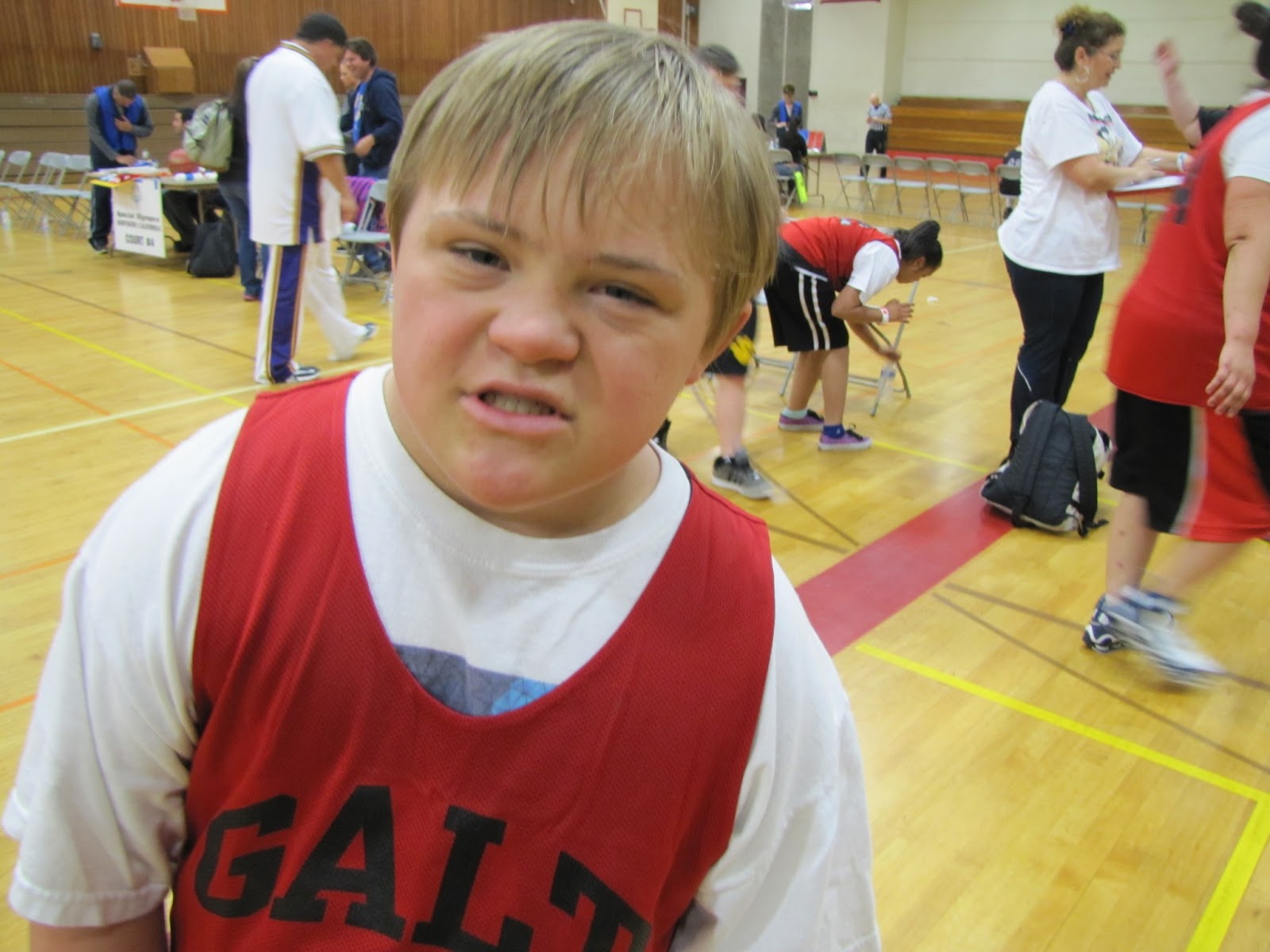
This last weekend was March Madness at our house.  It was the Special Olympics Northern California Basketball Tournament in Lodi.  Our team played their hearts out.  All smiles and fun times.  The kids are already looking forward to next year!  Next sports are track and field and swimming!  See you there.


On our way to play!

warm up time with the bg kids


Getting ready for opening ceremony


Chris waiting to bring in the Olympic Torch


What an honor to carry the torch


game face

lunch break


Score!


Be gentle.